
In my validation of the loadbox setup I used my mesa boogie single rectifier from the 90′ as a point of reference and discovered that the loadbox behaves very differently to the actual speaker. There’s a small Q boost at around 100Hz which the loadbox didn’t model properly and smaller differences in the mids and highs.
Fortunatly a friend left some amps at my place so I could measure them.
On todays frequency graph comparison:
- Mesa boogie single rectifier 50w with a presence control and two modes on the lead channel.
- Peavey 6505 with two channels, presence and resonance control.
- Marshall DSL Something with one channel with a presence control and resonance mod.
All power amps were measured going through the effects loop into the loadbox or speaker with a DI box in between.
Let’s start with the single rectifier as a point of comparison.
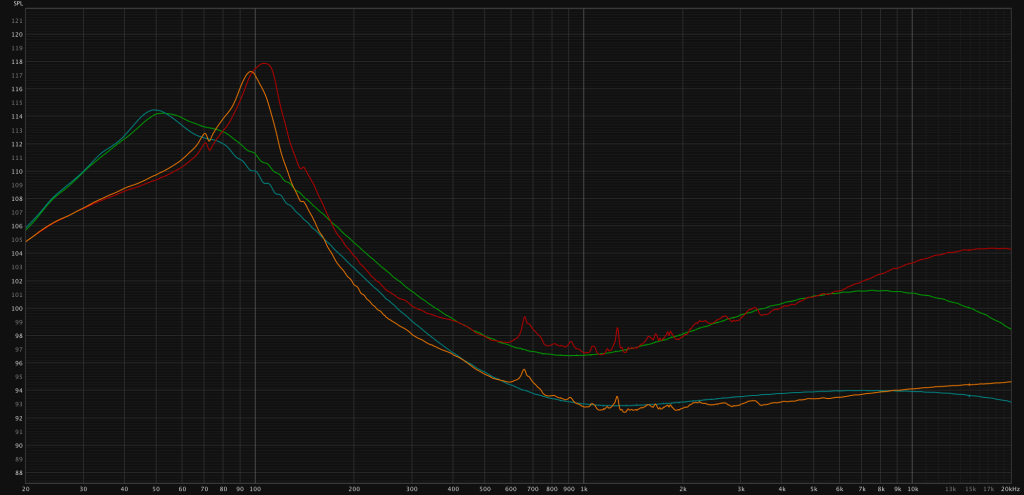
Just as a quick info, I tested if the presence control does anything but it seems to have no effect. It’s probably effecting the signal in the preamp.
Anyway, there the modern and vintage mode do differ in level. The modern mode is at least 2,5dB higher in level and has 10dB more highs. The shift in the resonance at 100Hz is probably due to the level change as the power amp is driven harder. See my other article for the behaviour at different levels.
The difference between the loadbox and speaker curves is again in the resonance peak around 100Hz, which is broader and shifted lower to about 50Hz (if the power amp is not hardly driven). There is a 2,5dB broad Q scoop happening between 170 – 400 Hz as well as some spikes in the midrange. The vintage mode also differs 0,5dB at 3,7kHz. While there is only a small difference of about 1 dB at >10kHz the modern mode has quite a drastic 4db on average difference from 6kHz up.
This means for correcting the curve we need a curve for one for each mode.
| Nr. | Typ | Frequenz | Gain | Q |
| 1 | Peak | 47,40 | -5,7dB | 2 |
| 2 | Peak | 107,5 | 8,2dB | 3 |
| 3 | Peak | 240 | -1,3dB | 1,6 |
| 4 | Peak | 691 | 2,1dB | 4.8 |
| 5 | Peak | 1256 | 0,9dB | 7,5 |
| 6 | Peak | 5000 | -0,7dB | 1 |
| 7 | High Shelv | 18000 | 6,9dB | 1 |
For easy of use bands 5 and 6 can be omitted. The error is less than 1dB 20Hz-20kHz for EQ matches.
| Nr. | Typ | Frequenz | Gain | Q |
| 1 | Peak | 45,20 | -5,9dB | 2 |
| 2 | Peak | 100,5 | 8,3dB | 3,1 |
| 3 | Peak | 226 | -1,6dB | 1.5 |
| 4 | Peak | 670 | 1,4dB | 8 |
| 5 | Peak | 3500 | -0,6dB | 1 |
| 6 | Peak | 5900 | -0,3dB | 3 |
| 7 | High Shelv | 13000 | 1,2dB | 1 |
For easy of use bands 5 and 6 can be omitted.
To conclude the single rectifier: just use the EQ match for the mode you’re in. Possibly the clean and pushed mode on the clean channel have different behaviour, I’ll need to measure them, too.
Let’s look at the peavey 6505:
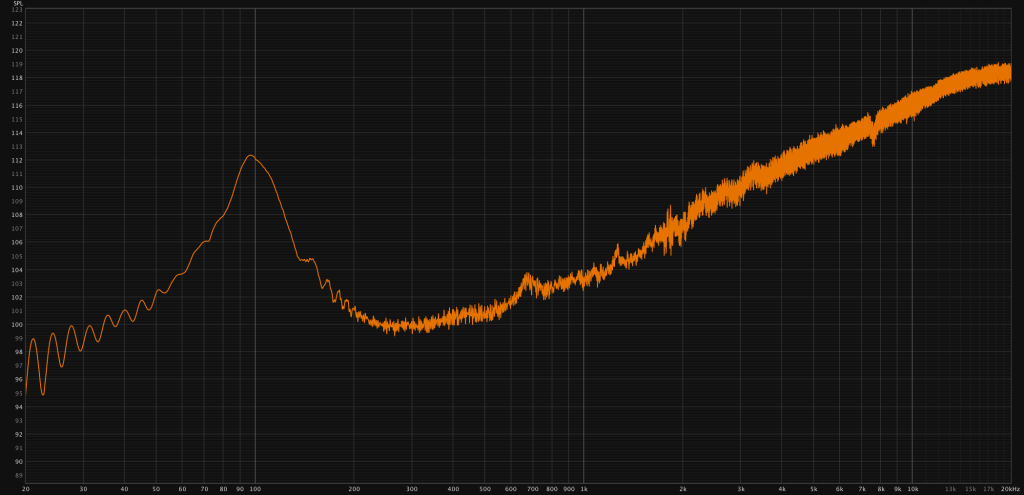
Firstly I could not max out the presence while measuring. From the setting at “9” to “10” (max) the measurement was broken when using a speaker. I don’t now why that is. I chose to leave the presence for the max setting at “9”.
Also when measuring the rythm vs the lead channel the results are the same so I’m not showing them here.
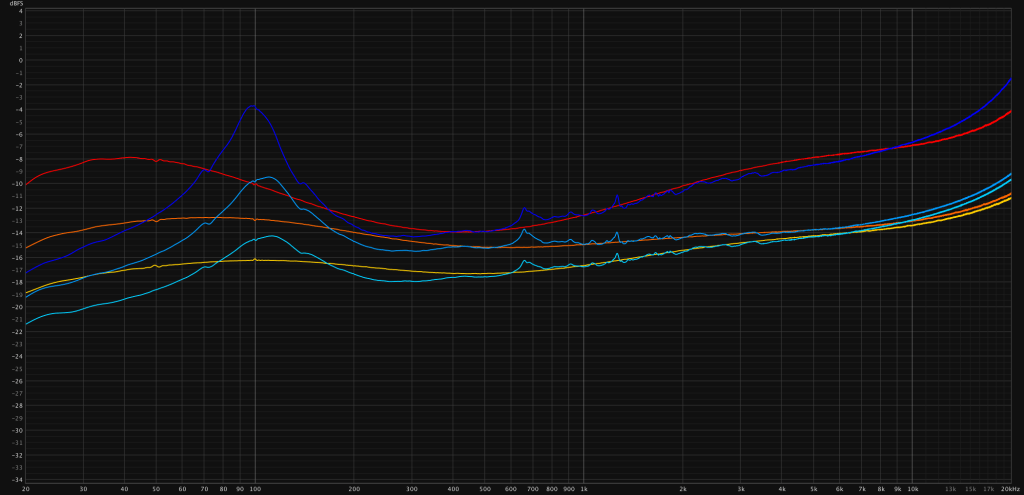
The peaveys resonance control seems to effect frequencies below 400Hz and controls the resonance peak at 100Hz. Even at the minimum setting a slight bump is visible, though the Q is much less narrow. At the maximum setting it look similar to the single rectifier, though is just 10dB higher instead of the 20dB from the rectifier. (No wonder it goes into power amp clipping so fast) The presence is actually doing something this time around. From 600 Hz onwards it boosts the treble and seems to do all work work between “noon” and “full”. Below 12 O’clock the presence doesn’t do much.
he differences in the speaker to the loadbox are somewhat dependend on the settings that are used. The difference between the lowend response are not able to be just solved with an EQ. If the resonance is set high the correction EQ must attenuate the frequencies below 70 Hz much more and has to emphesize the resonant peak much more. A singular correction will yield errors and sound noticably different. Basically you have to pick your favorite setting in advance and match that – or do EQ matching for each setting.
The dip in the response around 250Hz stays the same and can be statically EQed.
When the presence is set high the loadbox need to have the frequencies around 4kHz attenuated by about 1dB. This is definetly hearable yet a small difference that only manifests when the presence is set high. In my experience I would set the presence that high anyway because it doesn’t sound good.
So the same decision regarding an EQ-correction has to be made but I would argue that it is not that necessary.
The difference about 7kHz seems static and can be EQed easily by boosting the high end at around 17kHz with a high shelf by about 1.5dB. If you cut this frequency area with a LPF anyway you may omit that.
I would suggest 3 correction EQs.
- Static EQ
- Resonance settings EQ low, med, high
- Presence settings EQ high only
Resulting in 4 filter sets:
| Nr. | Typ | Frequenz | Gain | Q |
| 1 | Peak | 243 | -1,1dB | 1,4 |
| 2 | Peak | 427 | 0,2dB | 5 |
| 3 | Peak | 669 | 1,4dB | 7 |
| 4 | Peak | 870 | 0,3dB | 5 |
| Nr. | Typ | Frequenz | Gain | Q |
| 1 | Peak | 20 | -2,4dB | 2 |
| 2 | Peak | 31,6 | -1,7dB | 2 |
| 3 | Peak | 47,8 | -1,7dB | 2 |
| 4 | Peak | 110,5 | 2,2dB | 2,3 |
| Nr. | Typ | Frequenz | Gain | Q |
| 1 | Peak | 20 | -4dB | 2 |
| 2 | Peak | 31,85 | -2,7dB | 2 |
| 3 | Peak | 48,8 | -2,5dB | 2 |
| 4 | Peak | 108,5 | 3,9dB | 2,3 |
| Nr. | Typ | Frequenz | Gain | Q |
| 1 | Peak | 20 | -7,3dB | 2 |
| 2 | Peak | 31,55 | -4,5dB | 2 |
| 3 | Peak | 47,25 | -4dB | 2 |
| 4 | Peak | 101 | 7dB | 2,6 |
| Nr. | Typ | Frequenz | Gain | Q |
| 1 | Peak | 4000 | -0,7dB | 0,7 |
| 2 | Shelf | 12500 | 1,6dB | – |
Let’s look at the marshall amp next:
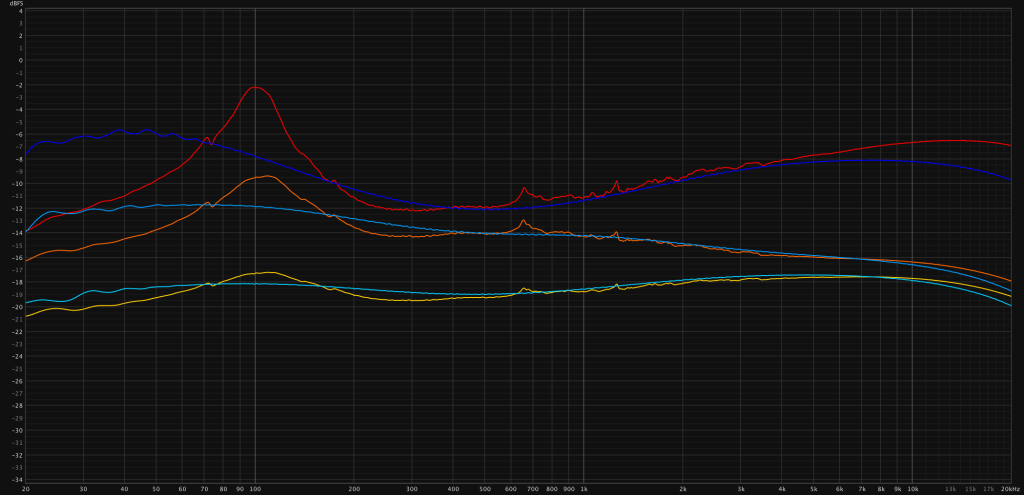
The marshall behaves quite similarly to the peavey. Start with the resonance around 100Hz the gain and Q rise with the setting. The dip around 250Hz is consistant. The presence doesn’t seem to do much between minimum and “noon.” But between “noon” and max response increases a lot in the high frequencies.
The differences between the loadbox and the speaker are like the peavey settings dependend.
Static: dip around 250Hz and minimal falloff above 10kHz(negliable).
Resonance: needs correction for low, med and high settings.
Presence: only needs a correction for high settings.
| Nr. | Typ | Frequenz | Gain | Q |
| 1 | Peak | 248 | -1dB | 1,6 |
| 2 | Peak | 428 | 0.3dB | 5 |
| 3 | Peak | 664 | 1,3dB | 8 |
| Nr. | Typ | Frequenz | Gain | Q |
| 1 | Shelf | 600 | 0,3dB | – |
| 2 | Shelf | 8000 | 1,7dB | – |
| 3 | Shelf | 16000 | 0,8dB | – |
| Nr. | Typ | Frequenz | Gain | Q |
| 1 | Peak | 20 | -5,6dB | 2 |
| 2 | Peak | 31,85 | -4dB | 2 |
| 3 | Peak | 48,6 | -3,3dB | 2 |
| 4 | Peak | 102,5 | 6,3dB | 2,6 |
| Nr. | Typ | Frequenz | Gain | Q |
| 1 | Peak | 24,1 | -3,1dB | 2 |
| 2 | Peak | 41,45 | -2,5dB | 2 |
| 3 | Peak | 106 | 2,9dB | 2,7 |
| Nr. | Typ | Frequenz | Gain | Q |
| 1 | Peak | 20,1 | -0,9dB | 2,4 |
| 2 | Peak | 32,80 | -0,9dB | 2,9 |
| 3 | Peak | 47 | -0,9dB | 2 |
| 4 | Peak | 106,5 | 1,1dB | 2,3 |
I am a little bit surprised that the differences between the loadbox and amp are that massive. I would really like to try a different reactive loadbox if another model get’s more close to the intended response.
 Alpha Sonic Studio
Leave a comment